
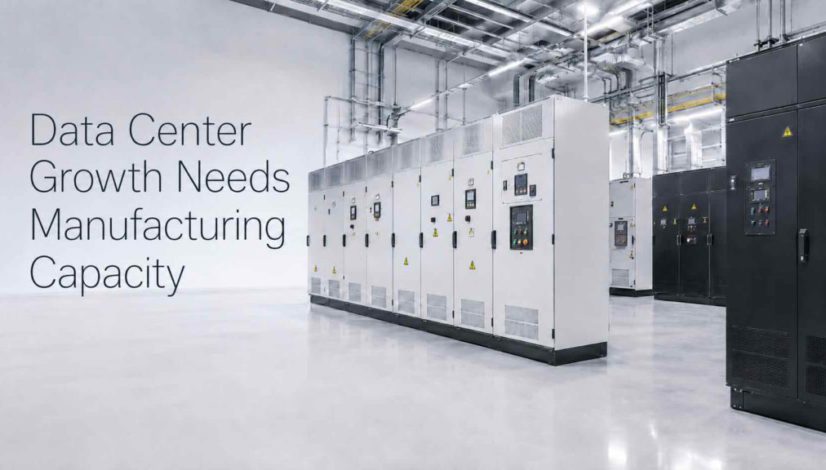
Data Center Electrical Equipment Manufacturing Support
The Hidden Manufacturing Constraint Behind AI Data Centers: Metal Parts, Enclosures, and Assemblies
Data Center Electrical Equipment Manufacturing Support for OEMs
AI data centers are creating massive demand for power, cooling, electrical infrastructure, and physical equipment. But behind the headlines about chips, servers, electricity, and grid capacity, there is another bottleneck that receives far less attention:
The ability to manufacture the metal components, enclosures, frames, cabinets, brackets, panels, skids, and assemblies needed to build data center infrastructure at scale.
For manufacturers of data center electrical equipment, this creates both an opportunity and a challenge. Demand is growing quickly, but internal production capacity, labor availability, coating capacity, fabrication lead times, and supply chain complexity can limit how fast OEMs can respond.
That is where a qualified contract manufacturing partner can help.
Prince Manufacturing supports OEMs and industrial equipment manufacturers with metal fabrication services, stamping, press braking, welding, coating, assembly, packaging, sequencing, and U.S./Mexico manufacturing options. For data center equipment manufacturers, this can help reduce production bottlenecks, expand capacity, and improve speed to market.
“According to the International Energy Agency, data centre electricity use continues to surge, creating new pressure on power infrastructure, grid investment, and equipment supply chains.”
Quick Answer: Why Data Center Equipment Manufacturers Need Metal Fabrication Partners
Data center equipment manufacturers need scalable metal fabrication partners because AI-driven data center growth is increasing demand for electrical equipment, power distribution systems, cooling infrastructure, enclosures, cabinets, brackets, frames, and assemblies. A contract manufacturing partner can help OEMs increase production capacity without immediately investing in new buildings, labor, equipment, or internal finishing operations.
Why AI Data Centers Are Changing the Manufacturing Supply Chain
Data centers are no longer just IT facilities. Modern AI data centers are power-intensive industrial infrastructure projects.
They require:
- Electrical power distribution systems
- Switchgear and switchboards
- Busway and busbar-related components
- UPS and battery backup systems
- Energy storage cabinets
- Generator and power skids
- Cooling and HVAC-related metal components
- Server and equipment support structures
- Cable management systems
- Metal enclosures, covers, guards, frames, and panels
Every one of these systems depends on fabricated, finished, assembled, and delivered physical components.
As data center demand grows, the pressure moves upstream to the companies that manufacture the equipment used inside and around those facilities. Electrical equipment OEMs, enclosure manufacturers, cooling system suppliers, power distribution companies, and industrial component manufacturers must find ways to produce more, faster, and with consistent quality.
The Overlooked Bottleneck: Metal Components
When people talk about data center constraints, they usually mention land, power, permitting, chips, transformers, or construction timelines. Those are real constraints.
But there is another constraint: manufacturing throughput.
Data center electrical infrastructure requires a large volume of metal parts and assemblies, including:
- Switchgear cabinets
- Electrical enclosures
- Control cabinets
- Power distribution enclosures
- Battery storage enclosures
- Busbar and busway support components
- Mounting brackets
- Formed panels
- Structural frames
- Cable trays
- Equipment guards
- Cooling system housings
- Painted and powder-coated components
- Welded assemblies
- Packaged and sequenced subassemblies
These parts may not be the most visible part of a data center project, but they are essential. If the cabinets, frames, brackets, panels, and finished assemblies are late, the larger equipment build can fall behind.
What This Means for Electrical Equipment OEMs
For OEMs serving the data center market, the challenge is not simply winning new orders. The challenge is fulfilling those orders reliably.
Many manufacturers are asking:
- Can we handle the increased volume?
- Do we have enough fabrication capacity?
- Do we have enough welding labor?
- Can our coating or painting line keep up?
- Should we invest in more equipment or outsource part of the work?
- Can we reduce lead times without sacrificing quality?
- Can we support customers in multiple regions?
- Can we nearshore part of the supply chain?
- Can we reduce supplier complexity?
These are strategic manufacturing questions.
The wrong answer can lead to late deliveries, excess overtime, quality problems, margin pressure, and frustrated customers. The right manufacturing partner can help relieve capacity constraints while allowing the OEM to stay focused on engineering, customer relationships, system design, and final program ownership.
Where Contract Manufacturing Helps Data Center Equipment Suppliers
A contract manufacturing partner can help data center equipment manufacturers by taking on specific part families, processes, assemblies, or overflow production.
This may include:
- Metal Fabrication
Fabricated metal parts are used throughout data center power and cooling infrastructure. A qualified partner can support laser cutting, turret punching, stamping, forming, press braking, welding, grinding, polishing, and secondary operations.
- Metal Finishing
Many data center equipment components require protective or cosmetic finishing. This may include powder coating, e-coating, liquid coating, CARC painting for specialized applications, sanding, blasting, and other finishing processes.
- Welding and Assembly
OEMs often need more than individual parts. They need welded frames, assembled panels, hardware installation, mechanical integration, electrical/mechanical subassemblies, kitting, and packaging support.
- Packaging and Sequencing
For large programs, delivery timing matters. Components may need to be packed, labeled, sequenced, staged, and shipped according to production schedules or installation needs.
- Nearshore and U.S./Mexico Production Options
Some parts may be best suited for U.S. production. Others may benefit from Mexico-based manufacturing because of labor content, volume, assembly requirements, or cost targets. A hybrid U.S. and Mexico approach can help OEMs balance cost, lead time, control, and flexibility.
Why OEMs Should Not Automatically Build More Internal Capacity
When demand increases, the natural reaction is to consider more equipment, more labor, more floor space, and more internal production capacity.
Sometimes that is the right answer. But not always.
Internal expansion can create risk:
- High capital investment
- Long equipment lead times
- Recruiting and training challenges
- More management complexity
- Higher fixed overhead
- Utilization risk if demand changes
- Bottlenecks in finishing, welding, or assembly
- Increased working capital pressure
Contract manufacturing allows OEMs to add capacity without carrying the full burden of new internal infrastructure. It can also help protect internal operations from overload during demand spikes.
The best approach is often not “make everything internally” or “outsource everything.” The best approach is usually a balanced manufacturing strategy.
OEMs should keep the most strategic, proprietary, or customer-facing work close while outsourcing selected fabrication, finishing, assembly, or overflow production to a qualified partner.
Best-Fit Data Center Components for Contract Manufacturing
Contract manufacturing can be especially valuable for metal-intensive and labor-intensive components used in data center infrastructure.
Examples include:
- Electrical enclosure parts
- Cabinet frames
- Doors and panels
- Mounting brackets
- Cable tray components
- Cooling system sheet metal
- Battery cabinet components
- Generator enclosure parts
- Power distribution unit housings
- Switchgear and switchboard metal components
- Busway supports and covers
- Welded base frames
- Painted and powder-coated assemblies
- Hardware-installed subassemblies
- Packaged kits and sequenced components
These components often require multiple processes. A supplier that can fabricate, finish, assemble, package, and ship can reduce the number of vendors involved and simplify the supply chain.
What to Look for in a Data Center Manufacturing Partner
Not every fabrication supplier is a good fit for data center equipment programs. OEMs should look for a partner with the right mix of capability, discipline, scale, and flexibility.
Important criteria include:
Multi-Process Capability
A strong partner should be able to support several manufacturing steps, not just one process. Fabrication, forming, welding, finishing, assembly, packaging, and shipping under one manufacturing umbrella can reduce handoffs and delays.
Quality Systems
Data center equipment manufacturers need repeatability. Look for a partner with quality systems, inspection discipline, documentation practices, and experience serving demanding OEM customers.
Finishing Capacity
Powder coating, e-coating, liquid coating, and other finishing processes can become bottlenecks. A partner with finishing capability can reduce transportation, lead time, and vendor complexity.
Assembly Support
Many OEMs need subassemblies, not just flat parts. A partner that can install hardware, assemble components, kit parts, label shipments, and sequence deliveries can provide more value than a basic fabrication shop.
U.S. and Mexico Manufacturing Options
A North American footprint gives OEMs more flexibility. Some projects may require U.S. production. Others may benefit from Mexico production or a hybrid model that combines U.S. and Mexico operations.
Transparent Communication
Speed matters, but so does predictability. OEMs need clear quoting, realistic lead times, responsive communication, and practical manufacturing feedback.
How Prince Manufacturing Supports Data Center Equipment OEMs
Prince Manufacturing helps OEMs scale production through contract manufacturing, metal fabrication, metal finishing, assembly, and U.S./Mexico manufacturing options.
Prince supports a wide range of manufacturing processes, including:
- Metal stamping
- Laser cutting
- Turret punching
- Press braking
- MIG, TIG, and spot welding
- Powder coating
- E-coating
- Liquid coating
- CARC painting
- Sanding and blasting
- Assembly
- Kitting
- Sequencing
- Packaging
- Shipping
Prince also offers both U.S. and Mexico manufacturing options, including contract manufacturing, shelter manufacturing, and hybrid models.
For data center equipment manufacturers, this matters because different parts of a program may require different manufacturing strategies. A high-mix, quick-turn component may fit one location. A labor-intensive assembly may fit another. A larger program may require a hybrid approach.
Prince gives OEMs more options.
U.S. Manufacturing, Mexico Manufacturing, or Hybrid: Which Is Best?
The right production model depends on the part, volume, labor content, customer requirements, delivery expectations, and total landed cost.
U.S. Manufacturing May Be Best When:
- Lead time is the top priority
- Volumes are lower or more variable
- Customer requirements favor domestic production
- Engineering changes are frequent
- The part requires close coordination
- Freight or logistics sensitivity is high
Mexico Manufacturing May Be Best When:
- The product is labor-intensive
- The program has stable or growing volume
- Assembly content is significant
- Cost reduction is a major goal
- North American proximity is important
- The customer wants nearshoring instead of overseas sourcing
Hybrid Manufacturing May Be Best When:
- Some processes are best done in the U.S.
- Some labor-intensive work is better suited for Mexico
- The OEM wants flexibility
- The program requires phased scaling
- The customer needs both speed and cost control
For many data center equipment manufacturers, the best answer may be a hybrid model that uses both U.S. and Mexico resources.
Why Nearshoring Matters for Data Center Equipment
Data center equipment programs often involve tight timelines, large components, sensitive delivery schedules, and high coordination requirements.
Nearshoring can help reduce risk compared with long overseas supply chains.
Potential advantages include:
- Shorter transportation routes
- Better communication across similar time zones
- Faster response to engineering changes
- Reduced overseas shipping exposure
- Improved supply chain control
- Lower labor cost for suitable work
- Easier executive and engineering visits
- Better alignment with North American customers
For OEMs serving U.S. data center projects, North American production can be a major strategic advantage.
The Strategic Question for OEMs
The question is not simply:
“Can we make this part?”
The better question is:
“Should we make this part internally, or should we use a manufacturing partner so our internal team can focus on the highest-value work?”
For data center equipment manufacturers, that distinction matters.
If internal teams are overloaded with fabrication, coating, welding, assembly, or packaging, then critical engineering and production resources may be pulled away from higher-value priorities. A contract manufacturing partner can help create more capacity without forcing the OEM to build everything internally.
Conclusion: The Data Center Boom Needs Manufacturing Capacity
The growth of AI data centers is creating demand across the entire electrical equipment and infrastructure supply chain.
That demand does not stop at transformers, switchgear, UPS systems, or cooling equipment. It reaches into the fabricated metal parts, painted components, welded frames, enclosures, brackets, panels, cabinets, assemblies, kits, and sequenced shipments that make those systems possible.
For data center equipment manufacturers, scalable production capacity is becoming a competitive advantage.
Prince Manufacturing helps OEMs respond to this demand with contract manufacturing, metal fabrication, finishing, assembly, packaging, sequencing, and U.S./Mexico manufacturing options.
If your team is facing capacity constraints, long lead times, overloaded fabrication departments, coating bottlenecks, or growing data center equipment demand, Prince can help evaluate which parts, assemblies, or programs may be a fit for outsourced or nearshore manufacturing.
Frequently Asked Questions
What types of data center equipment require metal fabrication?
Data center equipment that requires metal fabrication includes switchgear cabinets, electrical enclosures, UPS cabinets, battery storage enclosures, power distribution units, generator enclosures, cooling equipment frames, cable trays, brackets, panels, guards, and support structures.
Why are data centers increasing demand for fabricated metal parts?
Data centers require large amounts of electrical, cooling, and power distribution infrastructure. These systems depend on fabricated metal components such as cabinets, frames, panels, brackets, covers, enclosures, and assemblies.
“The global data center power market is projected to grow from $35.14 billion in 2025 to $50.51 billion by 2030, which supports the need for more scalable electrical equipment manufacturing capacity.”
Can contract manufacturing help data center equipment OEMs reduce lead times?
Yes. Contract manufacturing can help reduce lead times by adding external fabrication, welding, coating, assembly, packaging, and sequencing capacity. It can also reduce bottlenecks caused by overloaded internal production teams.
What should data center equipment manufacturers outsource?
OEMs may consider outsourcing fabricated parts, painted components, welded frames, enclosures, brackets, cabinet parts, hardware-installed assemblies, kitted components, and overflow production. The best candidates are often parts that consume internal capacity but are not the OEM’s core strategic differentiator.
Is Mexico manufacturing a good option for data center equipment components?
Mexico manufacturing can be a strong option for labor-intensive components, assemblies, and repeat production programs. It can help reduce cost while keeping production close to the U.S. market.
What is hybrid manufacturing?
Hybrid manufacturing combines more than one production model or location. For example, some work may be completed in the U.S. for speed and coordination, while other labor-intensive work may be completed in Mexico for cost efficiency.
Why choose a U.S. and Mexico manufacturing partner?
A manufacturing partner with both U.S. and Mexico operations gives OEMs more flexibility. It allows them to balance cost, speed, labor availability, production complexity, and customer requirements across multiple locations.
How can Prince Manufacturing help electrical equipment OEMs?
Prince Manufacturing can support electrical equipment OEMs with metal fabrication, stamping, press braking, welding, powder coating, e-coating, liquid coating, assembly, kitting, packaging, sequencing, U.S. production, Mexico production, shelter services, and hybrid manufacturing models. Mexico manufacturing and shelter services.
What are the best parts to send to Prince for review?
Good candidates include metal enclosures, cabinet components, brackets, panels, frames, welded assemblies, painted parts, powder-coated parts, kitted components, and repeat-production assemblies used in data center electrical, power, cooling, or infrastructure equipment.
How should an OEM start a conversation with Prince?
The best first step is to send drawings, annual usage estimates, current lead time challenges, quality requirements, finishing requirements, and any packaging or delivery expectations. Prince can review the opportunity and determine whether U.S. production, Mexico production, or a hybrid approach is the best fit.
